What Does OSHA Require for Farm Restrooms?
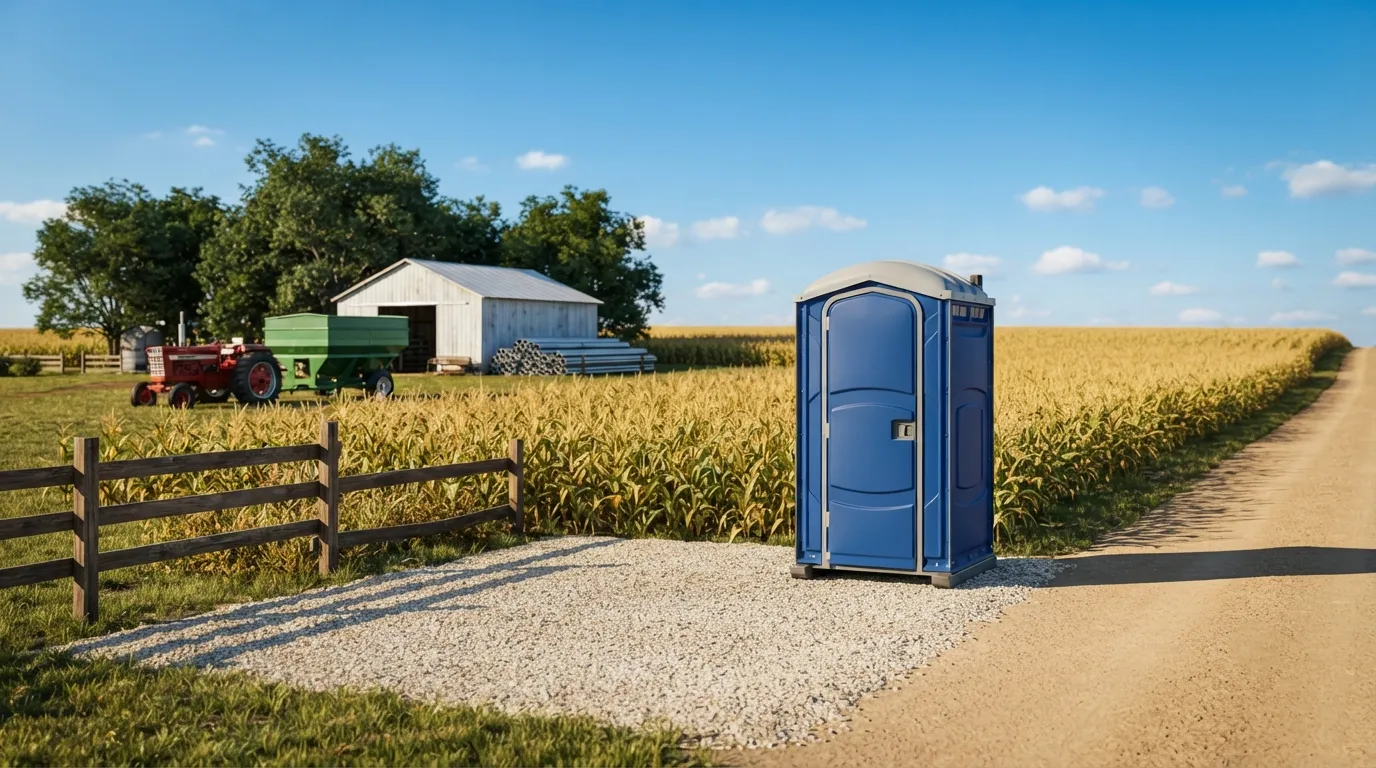
Field sanitation rules for agriculture come from OSHA 1928.110, and they're stricter on walking distance than most construction standards. Workers doing hand labor need potable water, toilets and handwashing within a quarter mile, at a ratio of one facility per 20 people. That's different from construction site services, which use OSHA 1926.51(c) instead: 1 toilet for 20 workers or fewer, then 1 toilet and 1 urinal per 40 workers once you cross 20, scaling to per-50 at 200 or more. Camarillo growers running crews across multiple fields often need several small clusters rather than one bank of units near the barn. We map out placement so the quarter mile rule holds even when a crew moves between blocks during the day. If your operation also runs a packing or processing building, that structure may fall under general industry rules instead, covered separately under 29 CFR 1910.141(c)(1)(i). Mixed operations, field crews plus a fixed packing house, sometimes need both standards applied to different parts of the same property. We've set up that split for operations near Camarillo and out toward Moorpark, 11.6 miles northeast, where crews shift between open field and covered sorting lines. Ask us which standard applies before the crew shows up, not after an inspector does.
How Many Units Does a Farm Crew Need?
A 40-person crew needs at least two toilet facilities under the 1928.110 ratio, and that number climbs fast on bigger operations. Use our how many porta potties do I need guide for a full breakdown by crew size, but the field math is straightforward: divide your headcount by 20, round up, and check that no worker walks more than a quarter mile to reach one. A standard porta potty rental holds 60 to 70 gallons and works fine for field use, standing about 92 inches tall with a 44 by 48 inch footprint that fits along a field edge or turnrow without blocking equipment. Seasonal harvest crews in Camarillo often need units moved as the picking front advances, and we schedule that as part of the service plan rather than a separate call. Pair every toilet cluster with a handwashing station rental; 29 CFR 1910.141(d)(2) requires soap and towels or a hand-drying device at wash stations, and hand sanitizer alone doesn't satisfy that. If your crew handles pesticide-treated equipment, washing facilities are separately required under OSHA 1926.51(f)(1) wherever herbicides or insecticides are applied, so a spray crew needs its own wash setup beyond the standard field station. We also stock portable sink rental units for packing sheds that need a fixed wash point near a loading dock.

Where Should Units Go on a Working Farm?
Placement matters more on a farm than almost any other job site, because equipment moves and ground conditions shift with irrigation and harvest. Our porta potty placement guide covers firm, level ground and clearance from ditches, but on agricultural land we also watch for spray drift zones and turn radius for tractors and trucks. A roll-off delivery for farm debris or packing waste needs about 60 feet of straight clearance behind the truck, which rules out some tight barnyard approaches. If you're running a mixed operation with a hospitality or agritourism component, an ADA accessible porta potty may be required for visitor areas even if the field crew units don't need it; ADA Standards section 213.2 requires at least 5 percent of a clustered unit group to be accessible, never fewer than one. Camarillo operations near event or tasting-room activity should plan for that overlap early. We also handle septic pumping service for farm labor housing and packing facility septic systems, and grease trap pumping for any on-site kitchen or processing operation. Growers farther out, toward Santa Paula, 18.5 miles north or Fillmore, 27.4 miles northeast, still fall inside our regular service routes, so distance from central Camarillo doesn't change the response time much.
| unit | duration | typical price |
|---|---|---|
| standard | week | 200 |
| standard | month | 200 |
| service_fee | month | 150 |
Monthly rates make sense for harvest-season crews running six to ten weeks; check our monthly porta potty rental page for the full breakdown, or porta potty rental cost for daily and weekly comparisons.
How often do farm units get serviced?
Weekly service is the baseline for up to 10 users over a 40-hour week, per ANSI/PSAI Z4.3. Larger crews or longer field hours need more frequent pumping. We adjust the schedule once we know your crew size and hours, and we can add mid-week service during peak harvest without a new contract.
Do I need a permit for farm restroom placement?
Placement on private agricultural land is different from placement in the public right of way, and that needs confirming with the city. We recommend checking with Camarillo before delivery if any unit sits near a public road or shared access point. See our porta potty permit requirements page for what to ask.
Can I get restrooms for a farm stand or agritourism event?
Yes. A farm stand or u-pick event needs event-grade planning, not field-crew units. Look at our event restroom rental or county fair restrooms pages for visitor-facing setups, including ADA units for public access areas.
What if my crew works multiple fields in one day?
We can split units across fields or move them as the crew relocates, keeping every worker inside the quarter-mile walk required by OSHA 1928.110. Tell us the daily rotation and we build a placement plan around it, not a single fixed spot.
Do handwashing stations need power or water hookup?
No. Our hand sanitizer station rental and handwashing units are self-contained, so they work in open fields with no utility access. See handwashing requirements for what 29 CFR 1910.141(d)(2) actually requires on site.
Next step
Get a delivery date
Tell us the address, the dates and the headcount. We size the order and confirm the route.